Making English for Tourism Real for Students

Dr. Maya Masita, M.Pd. | Member of APSPBI (a lecturer of Universitas Muhammadiyah Bulukumba and Journal Editor, Reviewer and Curriculum Consultant) https://www.linkedin.com/in/maya-masita/
Visualize a traveler arriving at a destination, eager to discover hidden stories, authentic flavors, and the unique spirit of a place. They do not want to hear generic facts found in any standard textbook; they want an experience that defines exactly where they are. Currently, however, many classrooms rely on repetitive drills that fail to capture this vibrancy. Education should be as dynamic and diverse as the destinations students represent. It is time to bridge the gap between abstract lessons and the real, bustling tourism industry by bringing the richness of local communities directly into the learning experience.
English for Tourism is described as a local and industry-sensitive field of study rather than generic English. The position taken here is that classrooms should stop using one-size-fits-all materials and instead use teaching tools that reflect the reality of the local tourism environment.
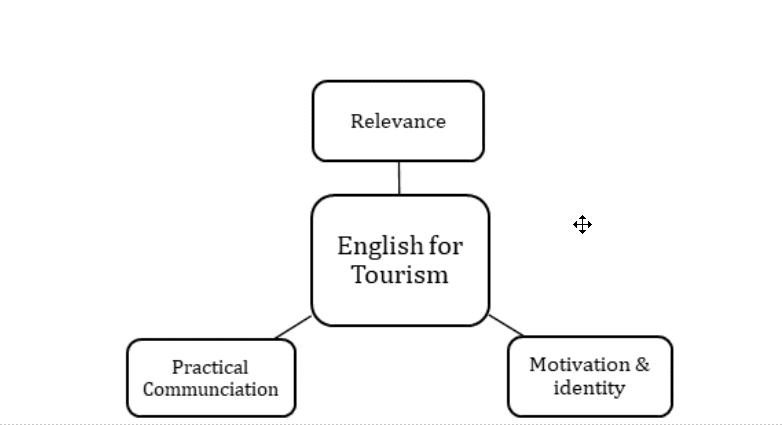
Relevance: Why Local Matters
Every tourist destination is different. Because local needs vary from one place to another, learning materials should clearly reflect those local realities. When students study English using local examples, such as their own regional food, specific tourism sites, and local culture, they can easily connect their English lessons to their real lives (Mubarok et al., 2024). This makes the language feel useful rather than abstract, helping students understand how to talk about their own homes to visitors.
Building Motivation and Identity
When local knowledge is used in the classroom, more is accomplished than just teaching vocabulary. Using materials based on local knowledge not only enhances students’ motivation and identity, but also linked to higher student motivation, identity, and cultural preservation (Boonsuk et al., 2026). When students can talk about their own heritage and traditions in English, they take pride in their work, which keeps them engaged and excited about learning.
Practical Communication for the Job
The end goal for most tourism students is to get a job in their local area. Therefore, English for tourism must be tied to workplace and industry-specific communication needs. If a student learns to describe the history of a local tourism sites or explain regional transportation options, they are practicing the exact skills they will need on their first day of work. By keeping the lessons focused on real-world industry tasks, students are better prepared for the workforce (Trang et al., 2024).
Changing how teaching is conducted comes with obstacles. There are often implementation problems such as not having enough resources, rigid curricula, or facing strict rules in the school system. However, these are not impossible to solve. They key is stakeholder collaboration, where teachers, business owners, and community leaders work together to create better materials. When everyone works as a team, these barriers can be overcome.
Overall, bringing local knowledge into English for Tourism classroom makes the subject more relevant, increase motivation, fosters a deep sense of pride in one’s local heritage, and provides the practical skills students need for their careers. These arguments consistently support the conclusion that teaching with a local focus is the best way to help tourism students succeed.
As Rita Mae Brown once said, “Language is the road map of culture. It tells you where its people come from and where they are going.” By grounding tourism education in local knowledge, educators empower students to confidently share their true cultural identity with the world.
References
Boonsuk, Y., Samae, R., Ka‐J, W., Wasoh, F. E., & Assalihee, M. (2026). When Marginalized Secondary Students See Themselves in Their ELT Textbooks: Cultural Engagement, Learning Motivation, Identity Formation, and Intercultural Awareness in Culturally Responsive Classrooms Amid an Ongoing Insurgency in Southern Thailand. International Journal of Applied Linguistics. https://doi.org/10.1111/ijal.70074
Mubarok, H., Anif, S., & Prayitno, H. J. (2024). Local Content Through Integrated Collaborative Learning: A Survey of Teaching Materials Needs. Journal of Educational and Social Research, 14(4), 271. https://doi.org/10.36941/jesr-2024-0102
Trang, T.T.T., Phuong, V.T. (2023). Needs Analysis About Intercultural Communicative Competence Among Undergraduate Tourism Students. J Psycholinguist Res 52, 2599–2620. https://doi.org/10.1007/s10936-023-10012-1
Hidayat Polim, MA | International Member of APSPBI (Soka University, Tokyo-Japan) polim@soka.ac.jp Editorial Note: This article has been reviewed and approved for […]
Cynantia Rachmijati | Member of APSPBI (English Education Study Program, Language Faculty, IKIP Siliwangi. Email: cynantiarachmijati@ikipsiliwangi.ac.id) Editorial Note: This article has been […]
Prof. Dr. Eny Syatriana, M.Pd. | Member of APSPBI (lecturer of English Education Department at Unismuh Makassar) Editorial Note: This article has […]